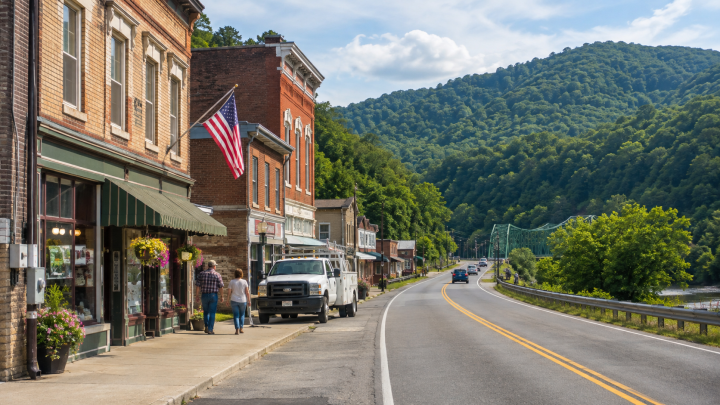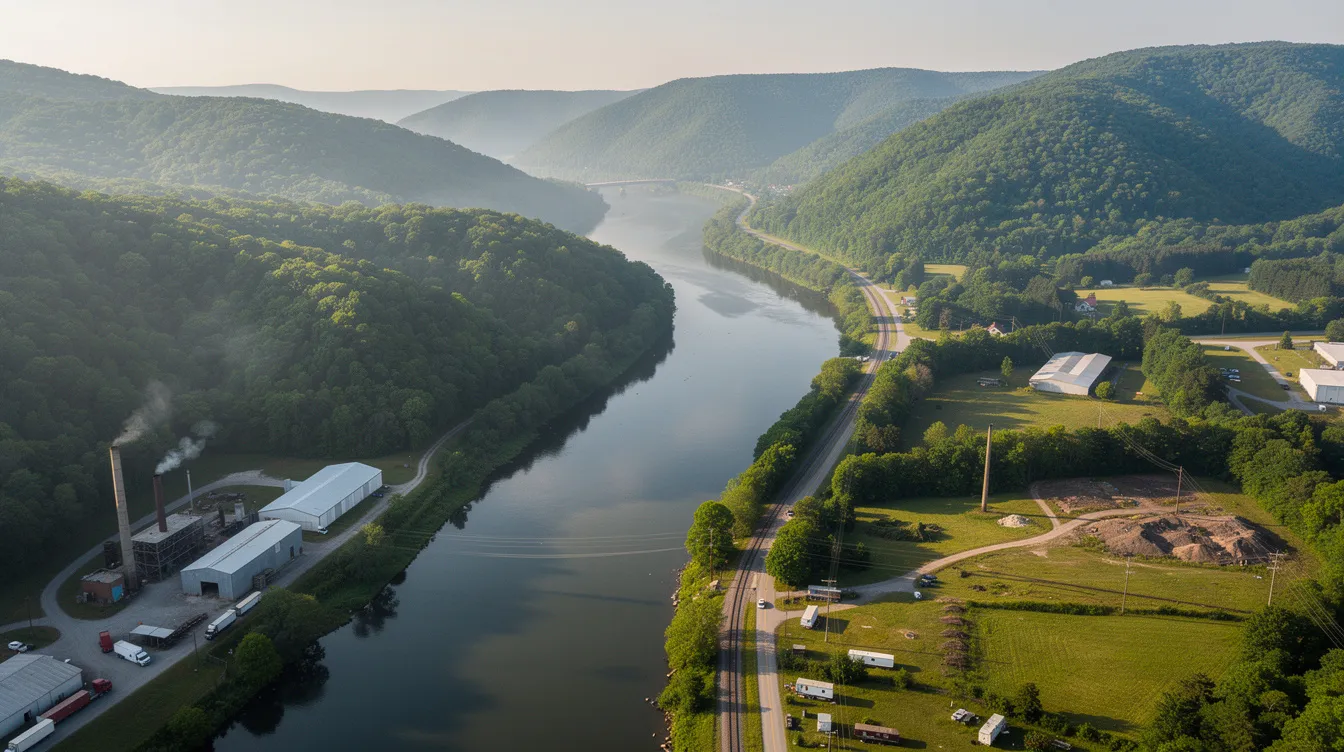
What does digital economic infrastructure actually do for a West Virginia business? It should do more than display a name on a directory page. A useful regional business hub gives business owners and authorized representatives a place to maintain information, publish updates, promote products and services, and reach customers across the communities they already serve. For rural economies, that practical difference matters.
What Is a Regional Business Hub, and How Does It Support West Virginia's Economy?
A regional business hub is a shared online destination that connects local businesses, communities, services, events, resources, and opportunities across a recognizable economic region. Instead of organizing everything around a single town or county boundary, it reflects where people actually travel, shop, work, hire, and conduct business.
A contractor based in Lewis County might serve homeowners in several neighboring counties. A retailer may attract visitors from farther along the I-79 corridor. A prospective employee may live in one community and work in another. These are normal patterns of regional commerce, yet the information people need is often scattered among separate websites, social accounts, and isolated business listings.
Regional business hubs are intended to make those connections easier to navigate. More importantly, a functioning hub can give participating businesses tools to maintain and communicate their own information, rather than relying entirely on a directory operator to publish every change.
Digital Economic Infrastructure Is More Than Broadband or Another Business Directory
Broadband, roads, utilities, industrial sites, and workforce training are essential investments. They help people and businesses operate. But digital economic infrastructure, as discussed here, describes an additional layer: organized, maintainable online systems that help customers, employers, suppliers, visitors, and institutions find relevant businesses and regional opportunities.
A basic business directory may list a company's name, address, and telephone number. A more capable regional hub can combine searchable business information with tools to share new offerings, publish expertise, advertise events, post jobs, and present images or videos. The information becomes something a business can actively maintain instead of a listing that slowly grows out of date.
This approach does not replace official economic development programs or local chambers. It creates an additional channel through which the businesses those organizations support can be discovered by the wider market.
How the State Gateway and the Regional Hubs Work Together
Mountaineer Business Network is West Virginia's public-facing statewide gateway. It provides context about the state's connected regional markets and directs people to the regional platforms where detailed business discovery and participation take place.
The regional hubs do the operational work: organizing local businesses and services, connecting neighboring communities, and providing member participation tools. The state gateway is not intended to reproduce every local business profile or compete with the regions for the same searches.
That statewide-to-regional structure is part of the broader framework developed by Regional Business Network. Its basic principle is straightforward: statewide connection, regional discovery, local participation.
A Working Example: Tygart Valley's Regional Business Hub
TygartValley.com provides a working example of the regional model in North-Central West Virginia. Visitors can explore communities, businesses, specialties, deals, events, and articles across a broader market rather than searching one municipality at a time.
But the public-facing pages are only part of the story. Behind the business listing is a member dashboard designed to let approved participants manage their presence and publish relevant content. That is what distinguishes a participating regional business network from a static collection of directory entries.
What Can a Business Actually Do With a Regional Hub Membership?
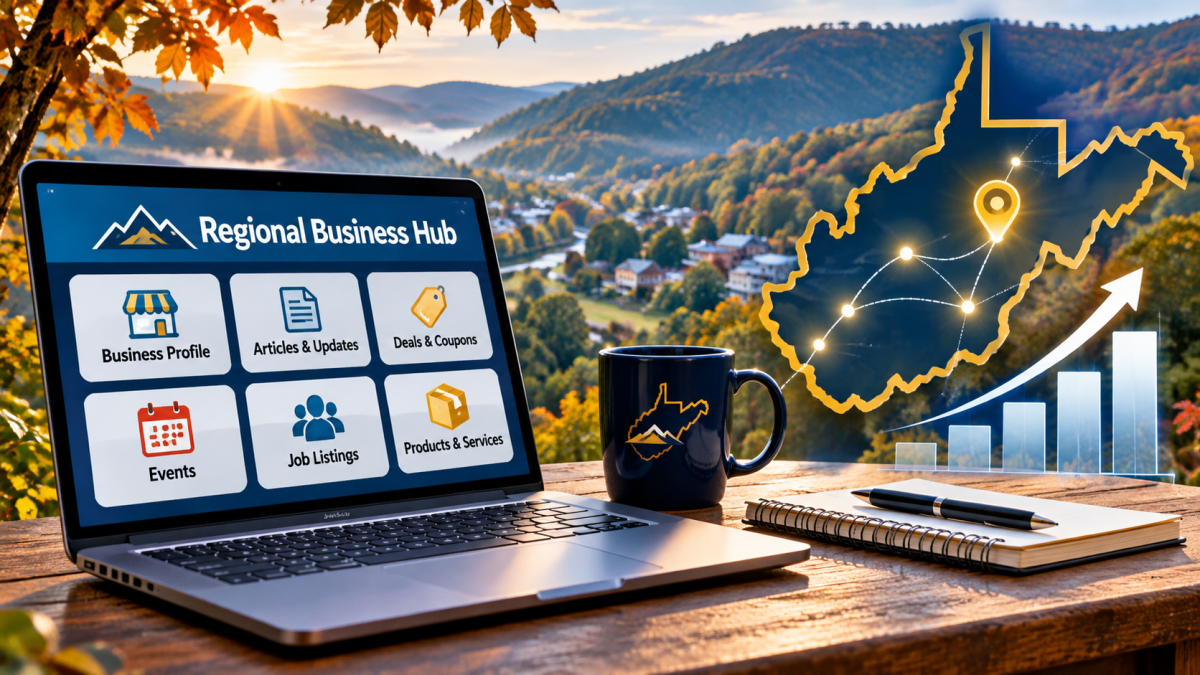
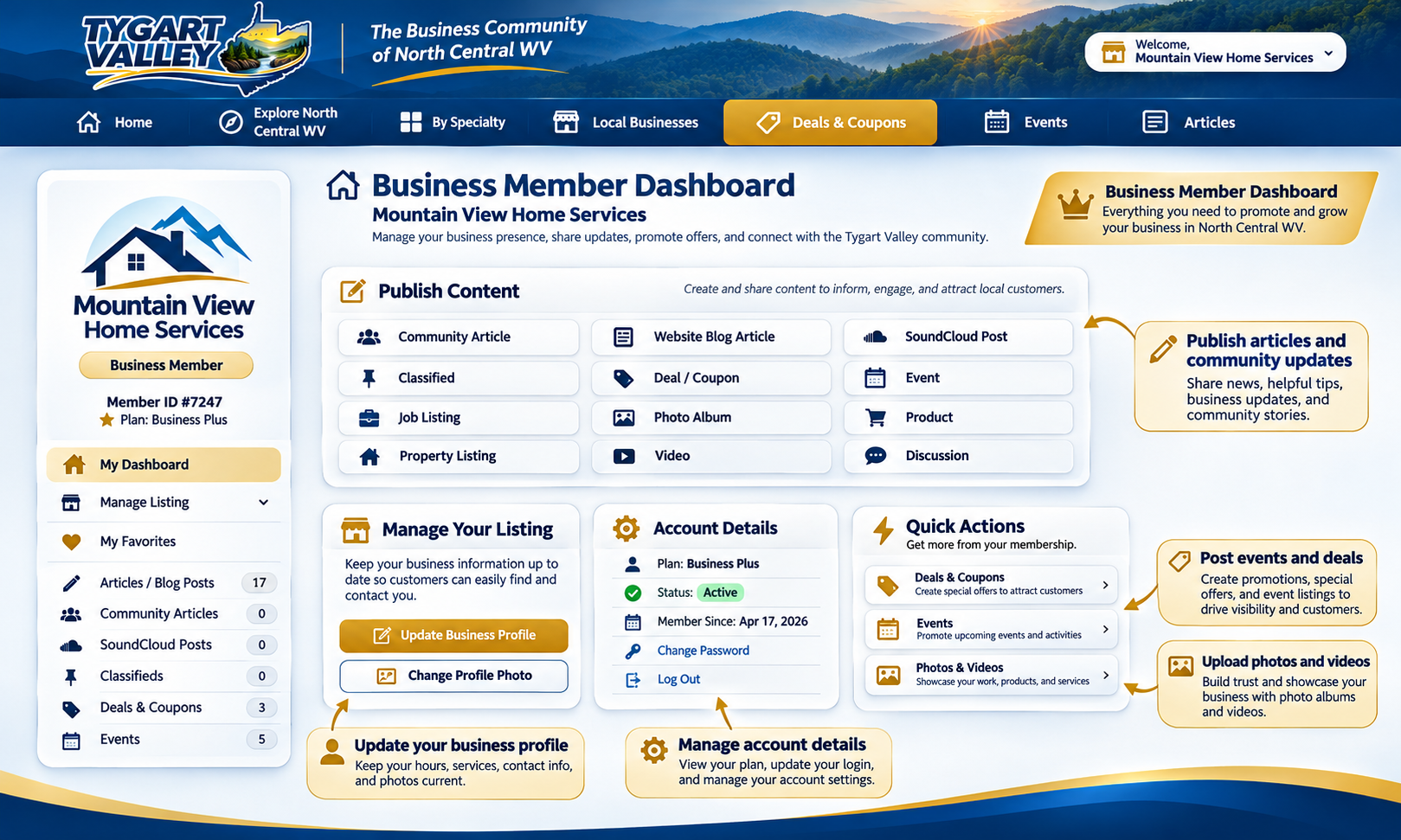
The dashboard above makes the infrastructure more tangible. Depending on the approved membership level and enabled features, a participating business or its authorized representative may be able to use the following tools.
Maintain a business profile customers can use
Keep contact information, services, descriptions, and profile imagery up to date so potential customers have a clearer understanding of what the business does and how to reach it. Profile maintenance is especially important when hours, service areas, or business offerings change.
Publish articles and community updates
Share helpful information, company updates, industry knowledge, and community stories through blog and community article publishing tools. A home services business could explain seasonal maintenance; a retailer could introduce a new collection; a community organization could share a local initiative. Useful publishing gives people more context than a brief directory description.
Create deals, coupons, and special offers
Publish promotions for products and services that could appeal to customers throughout the region. A business in one county may have an offer worth traveling for, while someone visiting a nearby community may discover it during trip planning. Offers give businesses a practical reason to keep their information current and give visitors a reason to return.
Promote events and activities
Announce workshops, open houses, seasonal sales, community gatherings, and other events when the relevant publishing feature is enabled. This helps a business communicate timely reasons for customers to visit or engage.
Post employment opportunities
Use job-listing tools to describe vacancies and reach people who may live outside the employer's home county. Rural labor markets regularly cross local government boundaries; regional information can help make those opportunities easier to find.
Showcase products, properties, photos, and videos
Depending on the available tools, businesses can present products, property listings, photo albums, and video content. Visual examples are particularly useful for contractors, home services, retailers, builders, hospitality businesses, and organizations whose work is easier to understand when customers can see it.
Publish other relevant content and manage the account
The sample interface also displays classifieds, audio-post options, discussion tools, and account settings. A participating member can manage available publishing areas and account information from one dashboard. Not every tool is necessarily appropriate for every business or included with every membership.
This is the economic distinction: the hub is not merely collecting information about businesses. It can give participating businesses a way to contribute, update, and promote information themselves within a shared regional discovery environment.
Why Business-Controlled Publishing Matters for Rural Economic Development
Small-town websites and local organizations often operate with limited staff and budgets. Keeping hundreds of individual business profiles updated by hand is difficult, particularly when information changes frequently. A member-managed model can distribute that work among the businesses and authorized representatives who know their offerings best.
That does not mean every business will regularly publish, or that every listing will remain accurate without oversight. It means the infrastructure provides a way for local participants to maintain their information directly, while the regional platform supplies structure and public discovery pathways.
For economic development organizations, that distinction may be useful when considering business retention and expansion, entrepreneurship support, local promotion, and community capacity. Instead of creating another isolated website for each project, an organization could evaluate whether an existing regional system can complement its programs and connect participating businesses to a broader audience.
Why Regional Markets Matter More Than Isolated County Listings
County and municipal identities remain important. Governments, chambers, planning councils, and tourism organizations have specific responsibilities that regional hubs should respect. Yet customer demand seldom follows the same lines as administrative jurisdictions.
A family may spend money in multiple counties during one weekend trip. A contractor might work throughout a regional corridor. A small manufacturer could seek suppliers or customers across neighboring communities. A business that appears only in a town-specific list may be missed by people who would willingly travel or hire from outside that town.
A regional hub can organize those connected choices without erasing local identity. A business still belongs to its home community, but it can also be discovered as part of a larger market.
What Economic Development Officials Should Evaluate
Digital economic infrastructure should be judged by its utility, not simply by whether it has an attractive homepage or a large number of imported business listings. Officials and institutions evaluating a regional platform can ask:
- Market relevance: Does the geography reflect where customers, workers, and businesses actually interact?
- Business participation: Can approved businesses or authorized representatives maintain accurate profiles and publish useful updates?
- Functional depth: Does the platform support more than names and addresses—for example, articles, offers, events, jobs, and visual content?
- Organizational fit: Can it complement existing chambers, workforce organizations, economic development programs, and publishers without replacing their responsibilities?
- Maintainability: Is there a practical way to keep information useful over time?
- Measurable activity: Can the operator assess participation, updated profiles, content publishing, engagement, referrals, or inquiries without overstating their economic impact?
The U.S. Economic Development Administration's CEDS guidance provides a framework for thinking about economic development strategies and evaluation. The Appalachian Regional Commission's investment priorities also address business development, infrastructure, and community capacity. A private regional business hub is not an official program of either organization, but its capabilities can be considered in the context of broader economic development needs.
Regional Hubs and AI-Driven Business Discovery
Search habits are evolving. Instead of looking only for a company name, people may ask: Who installs heating systems near Weston? Where can I find a local business offering a weekend special? Which employers are hiring in this part of North-Central West Virginia?
Accurate business descriptions, service-area context, well-organized categories, timely articles, and clear links can make published information more useful to people and easier for search systems to interpret. This does not guarantee placement in search results or AI-generated answers, but it gives businesses a stronger foundation than an incomplete or abandoned listing.
Digital readiness begins with information that is specific, maintainable, and helpful—not with claims that any particular system can control what an AI assistant recommends.
Frequently Asked Questions
What is a regional business hub?
A regional business hub is an online discovery and participation platform that connects businesses, services, events, and communities across a functional economic region rather than one town or county.
What makes a regional hub different from a basic directory?
A basic directory primarily displays listings. A participating regional hub can also provide account tools that let approved members update business profiles and publish articles, offers, jobs, events, photos, and other content, subject to enabled features.
Can every Tygart Valley business use every dashboard tool?
Not necessarily. Membership is subject to approval, and publishing permissions and features may vary. The dashboard image is an illustrative overview, not a promise that every tool is available under every plan.
Is Mountaineer Business Network itself the business dashboard?
No. Mountaineer Business Network is West Virginia's statewide public gateway. The regional hubs, such as Tygart Valley, provide detailed discovery and member functionality.
Does this replace economic development agencies or chambers?
No. The network is private digital infrastructure that can complement established organizations and their programs. It is not a government agency or an official regional planning district.
From Digital Presence to Regional Participation
Rural businesses need more than another place to be listed. They need understandable ways to present their services, share timely information, and become visible to customers and opportunities across the markets they already serve.
Tygart Valley offers a tangible example of that approach: regional discovery supported by member publishing tools. Mountaineer Business Network provides the statewide point of connection, while Regional Business Network explains the broader economic infrastructure framework.
The goal is simple: keep businesses rooted in their communities while making regional participation easier to discover, maintain, and expand.