West Virginia businesses and communities plan in an economy that can turn quickly. A plant announcement, a federal grant, a mine closing, a new data center or a wave of automation can change a county's outlook within a year. Scenario planning is a simple way to prepare for several of those futures at once instead of betting on one forecast. This guide shows how a small business, a county commission or a development authority can run one in an afternoon.
Key Takeaways
- Scenario planning means writing out three or four plausible futures and deciding in advance how you would act in each one.
- It is not a forecast. The goal is to find decisions that make sense in most futures, and early signs that tell you which future is arriving.
- In West Virginia, the forces most worth planning around are energy markets, federal and state funding, workforce and population, technology and AI, and large project announcements.
- A small business can do a useful version in two to three hours. A county or region can do a fuller version over two workshops.
What Scenario Planning Is, and What It Isn't
A budget or a forecast picks the most likely future and plans for it. Scenario planning admits that you don't know which future is coming. You describe a few different ones, each believable, and test your plans against all of them.
The value comes from three outputs:
- Robust moves: actions that pay off in every scenario. Do these now.
- Contingent moves: actions that only make sense in one scenario. Prepare them, but wait.
- Signposts: things to watch that tell you which scenario is unfolding, so you know when to act on a contingent move.
The Forces That Shape West Virginia Scenarios
Every business and county has its own drivers, but these five come up again and again across the state:
- Energy markets. Coal, natural gas and power prices affect jobs, severance tax revenue and the spending power of whole regions.
- Federal and state funding. Infrastructure, broadband, Appalachian Regional Commission and economic development grants can start or stall projects. Our guide to West Virginia economic development tracks current investment.
- Workforce and population. Hiring depends on who is available locally and who commutes in. See the West Virginia workforce and employment outlook.
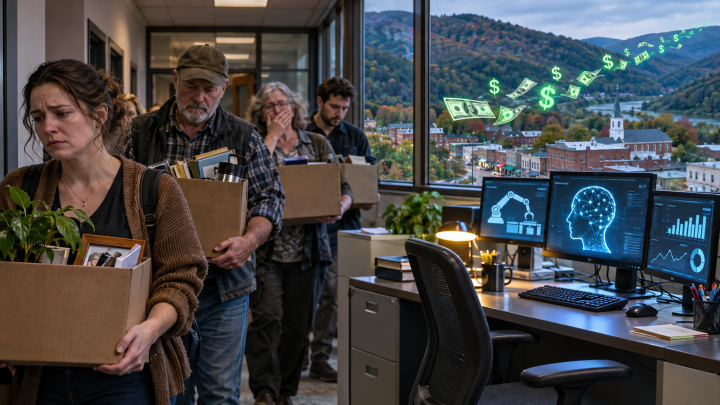
- Technology and AI. Automation can cut costs for a small firm and cut jobs in a county at the same time. We cover the local budget side in AI job disruption in West Virginia.
- Large project announcements. A new manufacturer, hospital expansion or data center can change housing, traffic and supplier demand across several counties.
A Five-Step Scenario Plan for a Small Business
Step 1: Write the decision you are facing
Scenario planning works best around a real choice. For example: "Should we open a second location in the next two years?" or "Should we hire two more crew members this spring?" Write it at the top of the page.
Step 2: List what could change, then pick the two biggest unknowns
List everything that would affect the decision: customer demand, costs, labor, competition, regulations, a major local employer. Then circle the two that matter most and that you are least sure about. Those two become the axes of your scenarios.
For a Clarksburg-area contractor, the two might be "Does the big regional project break ground?" and "Can we find skilled labor?"
Step 3: Build four scenarios from the two unknowns
Combine the two unknowns into a simple grid. Each square is one future. Give each a short, memorable name.
| Labor is available | Labor is scarce | |
|---|---|---|
| Project breaks ground | "Boom we can staff": grow fast | "Boom we can't staff": raise prices, subcontract, train |
| Project stalls | "Steady local work": compete on service | "Lean and tight": protect margins, stay small |
Write two or three sentences for each scenario describing what a normal month looks like.
Step 4: Test your options against each scenario
Take the decision from Step 1 and ask how it plays out in each square. Some options work everywhere. Those are your robust moves. In the contractor example, cross-training current staff and building a list of reliable subcontractors help in all four futures. Buying a second truck only pays off in the two "breaks ground" futures.
Step 5: Pick your signposts and set a review date
Choose two or three things you can watch: a permit filing, a county commission vote, job postings at a large employer, or your own quote requests. Put a review date on the calendar every quarter. When a signpost moves, revisit the contingent moves.
Scenario Planning for Counties and Communities
County commissions, development authorities and chambers face the same uncertainty at a larger scale, with budgets and public services attached. A practical approach:
- Bring the right people. Include the county commission, the development authority, the school system, the largest employers, a bank, the health system and a few small business owners. Different views produce better scenarios.
- Plan across county lines. Workers, shoppers and suppliers cross county lines every day. Scenarios work better at the level of a regional economy. Your regional planning and development council is a natural host.
- Tie scenarios to the budget. For each scenario, estimate the direction of B&O, property and sales tax revenue, and the demand for services. That shows where the budget is most exposed.
- Turn robust moves into projects. Broadband, workforce training, site readiness and helping local businesses get found online tend to pay off in most futures. They are strong candidates for grant applications.
- Publish the signposts. Sharing what the community is watching builds trust and lets businesses plan alongside local government.
Common Mistakes to Avoid
- One good, one bad, one middle. Scenarios that are just optimistic, pessimistic and likely don't teach much. Build them from two real unknowns instead.
- Too many scenarios. Four is plenty. More than that and nobody remembers them.
- Planning once and filing it away. The signposts and quarterly review are what make the exercise useful.
- Ignoring what you can control. Scenarios describe the outside world. Your response, such as your pricing, hiring, training and visibility, is where the plan pays off.
Free Help and Data
- The West Virginia Small Business Development Center offers free business planning support.
- Our guide to West Virginia small business grants and loans lists funding that can carry out robust moves.
- The West Virginia regions map shows which regional hub serves each county, a useful starting point for planning across county lines.
Regional business hubs give owners and communities a shared place to publish updates and reach customers across a whole region. Read what a regional business hub does, or join through your region.
Frequently Asked Questions
What is business scenario planning?
It is a planning method where you describe several plausible futures, test your options against each one, and pick actions that work across most of them. It prepares you for uncertainty rather than predicting one outcome.
How is scenario planning different from forecasting?
A forecast picks the most likely future. Scenario planning deliberately considers several, so you are not caught off guard if the forecast is wrong.
How long does scenario planning take?
A small business can complete a useful version in two to three hours. A county or regional effort usually takes two workshops plus time to gather data.
How often should I update my scenarios?
Review signposts every quarter and rebuild the scenarios once a year, or sooner if a major event changes your local economy.